FrameJacked - Hijacking Windows Frame Server with a
Fake Webcam
DZONERZY
Monday, 27 July, 2026
AI 1 - Humans 0
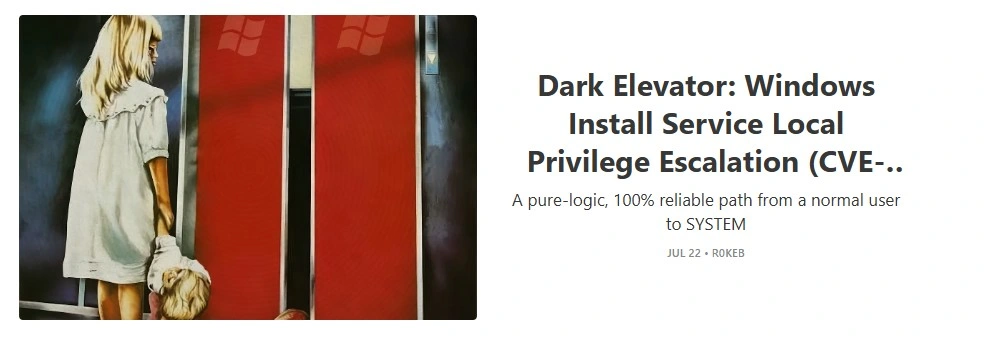
Screenshot of the calif.io Dark Elevator
blog post
A few weeks ago the folks at calif.io started
dropping a bunch of really cool writeups about vulnerabilities they
found with the help of AI. Their latest one, Dark
Elevator, is a beautiful Windows 11 LPE: a normal user gets an
interactive NT AUTHORITY\SYSTEM shell, no admin, no UAC, no
reboot, the full package. Microsoft fixed it on July 14th as
CVE-2026-50343.
Now, huge respect, ’cause that’s a clean logic-flaw chain and a great
read. But it also left me with that itchy feeling every offensive
researcher knows… if the AI found one bug in that area, what else is
lying around?
So I did what any reasonable person would do on a weekend, I opened a
disassembler and went down the rabbit hole. Spoiler: I came back with my
own ride to SYSTEM, on fully patched Windows 11 24H2
and 25H2. Same plantable DLL at the heart of it, completely different
elevator.
This is the story.
Their bug, in 30 seconds
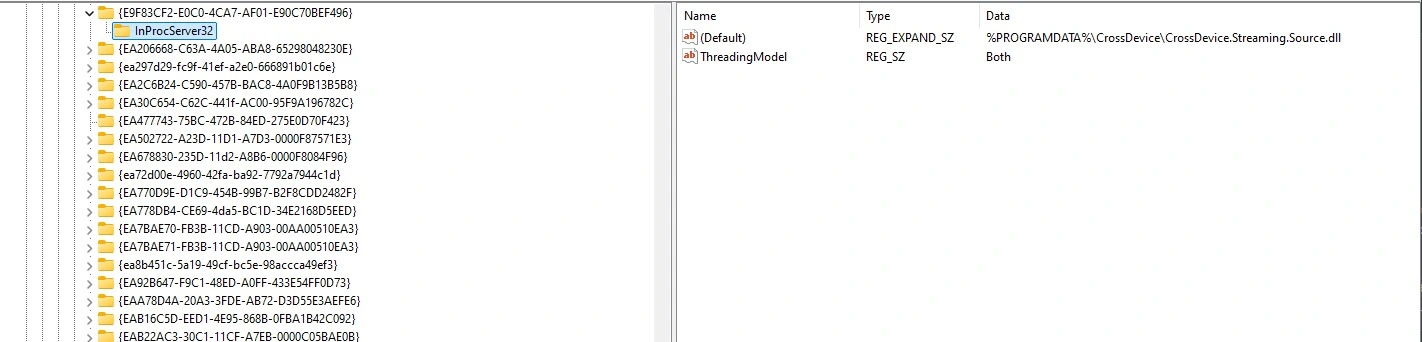
Regedit showing the CrossDevice CLSID
InprocServer32 pointing to C:
All credits to calif.io for the original find, but let me do a quick
recap so we’re on the same page. Their exploit chained two logic
flaws:
A writable plugin map. InstallService (the SYSTEM
service behind app installs) picks a COM class to load by reading a
registry key, StaticPluginMap, that any normal user can
write. Write your own CLSID there and the SYSTEM service will
CoCreateInstance whatever you point at.
A user-plantable COM server. Windows ships a
CrossDevice streaming component, CLSID
{E9F83CF2-E0C0-4CA7-AF01-E90C70BEF496}, whose
InprocServer32 points to
C:\ProgramData\CrossDevice\CrossDevice.Streaming.Source.dll.
The registration lives in HKLM so you can’t touch it… but
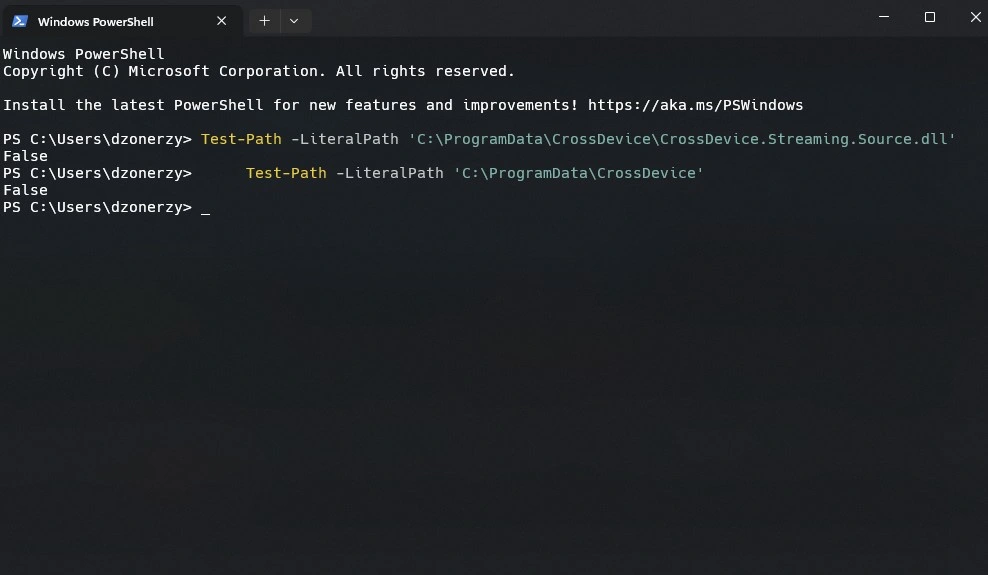
the DLL it points to doesn’t exist, and
C:\ProgramData is a place where any standard user can
create directories and files.
Plant the DLL, poke the service, and your code runs inside a SYSTEM
svchost.exe. Elegant, deterministic, no memory corruption.
Chef’s kiss 😀.
The real treasure was the DLL
Test-Path showing the CrossDevice DLL is
missing
Reading their post, the thing that kept my attention wasn’t
InstallService, but that weird stale COM registration: a
machine-wide HKLM registration, protected from
modification, pointing to a file that doesn’t exist in a directory any
user can create. If that’s not a bug, it’s at least a very generous
gift.
Microsoft’s fix for CVE-2026-50343 took care of the InstallService
side of the story. But that CrossDevice registration is still there,
still pointing to a missing DLL in a path any user can create. Fully
updated system, mind you.
So I asked myself, InstallService can’t be the only
privileged process willing to load that class, right? Who else wants my
DLL? I went hunting for another elevator.
Say cheese!
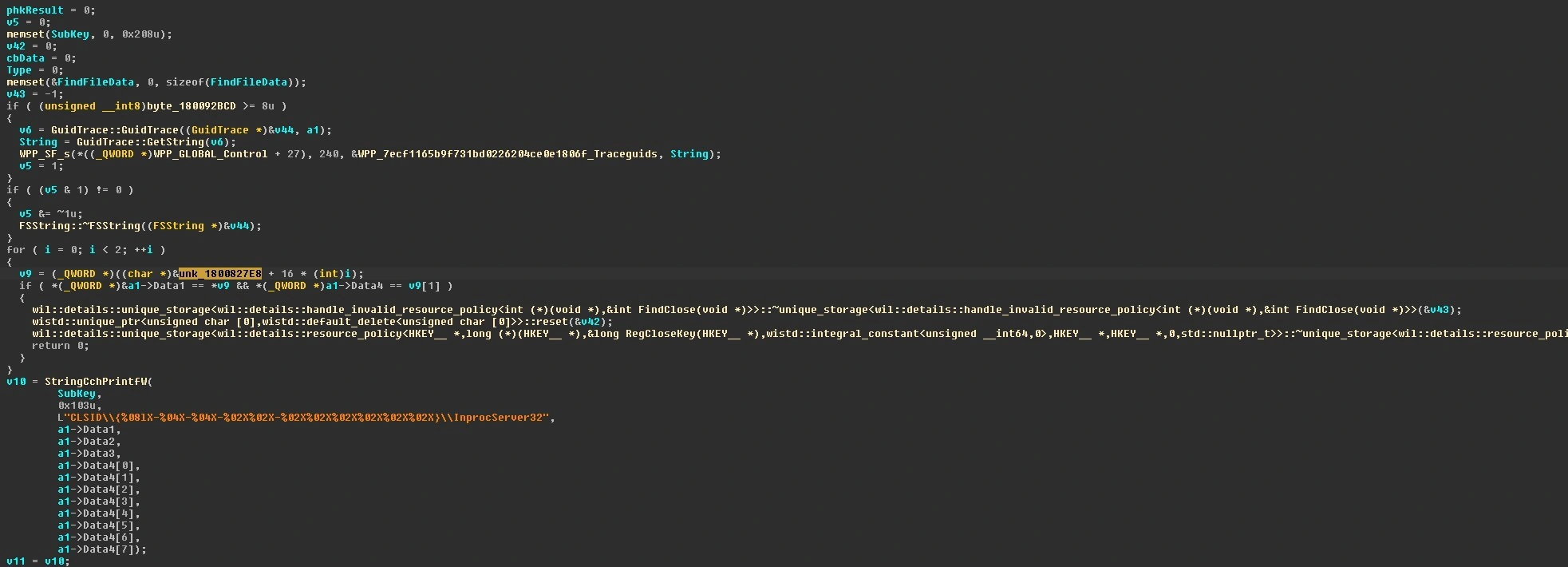
Decompiler view of VerifyCOMServerByClsid
in mfsensorgroup.dll
Turns out Windows has a whole infrastructure for virtual
cameras (the thing apps use to expose fake webcams), and it
comes with a public API, MFCreateVirtualCamera, that lets
you create a camera backed by a COM class of your choice. Nice feature,
eh? And guess which CLSID gets special treatment in there?
While reversing mfsensorgroup.dll something caught my
attention 🥁 … a function called VerifyCOMServerByClsid,
that compares the requested class against a small internal allowlist…
and guess what, our beloved CrossDevice CLSID is on it. A matching class
is accepted through a special-case path instead of getting the normal
COM-server-path validation. The protected registration stays usable even
though it resolves to an absent DLL in a user-creatable location. On the
analyzed image (file version 10.0.26100.8737, SHA-256
F6C21838...5761671, for the nerds keeping score) the
CrossDevice entry sits at 0x1800827F8.
Create the camera with the CrossDevice CLSID, call
IMFVirtualCamera::Start, then GetMediaSource…
and the Windows Frame Server - a service running as
NT AUTHORITY\LOCAL SERVICE - happily loads your
media source.
Now, LOCAL SERVICE is not SYSTEM, I know, but stay with me for a
second.
The media source from hell
But of course there’s a catch, ’cause there’s always a catch. You
can’t just drop a DLL with a class factory and call it a day: the Frame
Server expects a functional Media Foundation source before it
completes the activation path. Streams, descriptors, the whole
ceremony.
So a good chunk of this project was writing a complete, valid
IMFMediaSource implementation
(SimpleMediaSource.cpp, SimpleMediaStream.cpp,
friends…) just to convince the service to keep us around long enough to
have fun. The final PoC embeds the whole DLL as an RCDATA
resource inside a single exploit.exe, plants it with
CREATE_NEW (it politely refuses to overwrite anything that
isn’t its own), and activates the camera through a child process.
It’s potato time
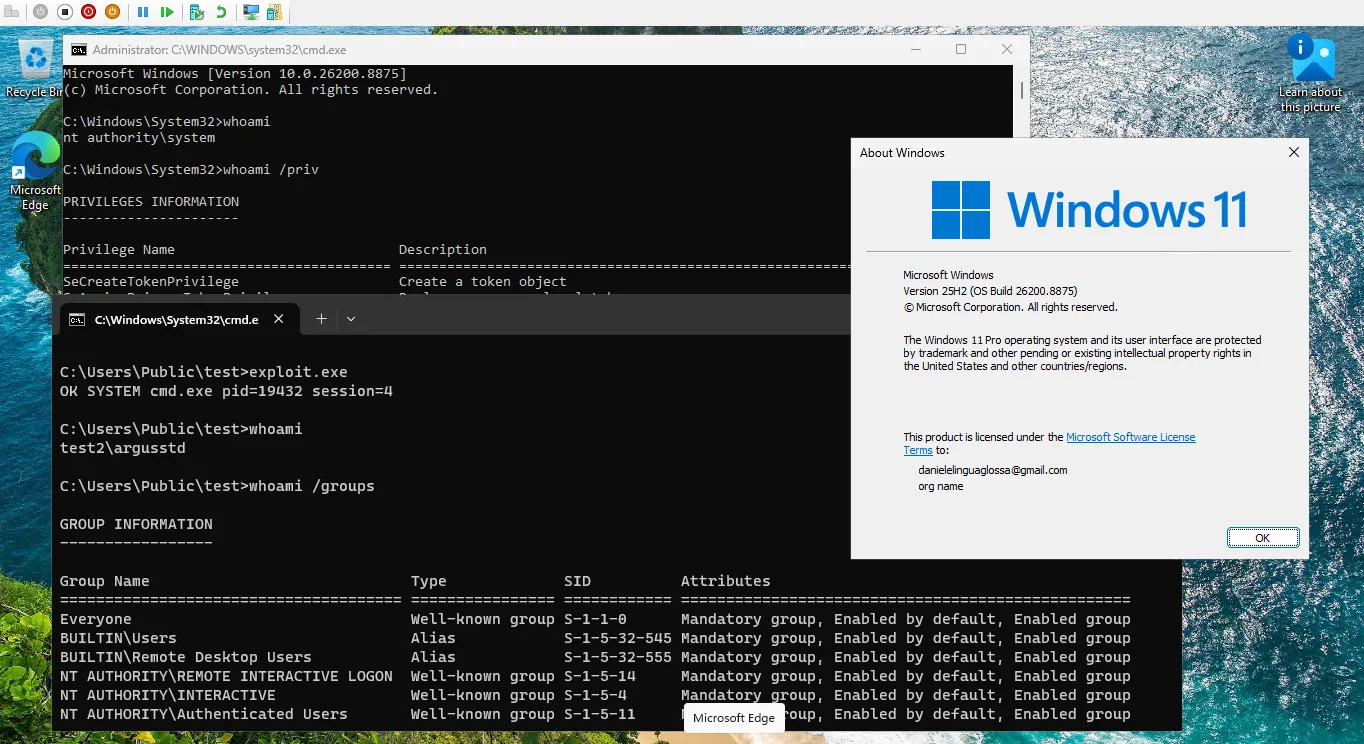
Console showing the exploit output OK
SYSTEM cmd.exe
And here’s why LOCAL SERVICE is more than enough: the Frame Server
process token is unrestricted, not AppContainer, and
has SeImpersonatePrivilege enabled. If
you’ve been in the Windows trenches for a while, your mouth is already
watering: that’s potato country.
The payload gates itself on the host identity (it only proceeds if
the process token is S-1-5-19, LOCAL SERVICE), then runs
the well-known EFSR coercion pattern - the same family as CoercedPotato:
Create a randomized named pipe,
\\.\pipe\<UUID>\pipe\srvsvc.
Call EfsRpcOpenFileRaw over the local EFSR RPC endpoint
(ncalrpc) with a path that resolves to our pipe.
The EFSR service connects to us. We call
ImpersonateNamedPipeClient, open the thread token, and
check it against WinLocalSystemSid.
Only if the captured token is verified as
NT AUTHORITY\SYSTEM (S-1-5-18) do we continue
- no blind trust, this is a civilized exploit.
DuplicateTokenEx to get a primary token,
TokenSessionId to pin it to the active interactive session,
winsta0\default, and CreateProcessAsUserW for
good old cmd.exe.
And there it is, an interactive SYSTEM shell popping
up in your own user session. No admin, no UAC, nothing.
The exposure
Standard user to SYSTEM, which means game over: bypass UAC and local
ACLs, read other users’ data, install persistent privileged stuff, own
the box. Suggested severity High, CVSS 3.1
7.8
(AV:L/AC:L/PR:L/UI:N/S:U/C:H/I:H/A:H).
Confirmed on fully serviced builds:
Operating system
Build
Result
Windows 11 Pro 24H2 x64
26100.8894
Confirmed - full chain from medium-integrity standard user to
SYSTEM
Windows 11 Pro 25H2 x64
26200.8875
Confirmed - same standalone exploit from a freshly created non-admin
account
This is not a claim that every edition is affected: Windows
10, Home, Enterprise and 26H1 weren’t tested.
Worth noting: the CrossDevice/Media Foundation area already received
security servicing (CVE-2025-24076,
CVE-2026-21508),
and calif.io’s path was fixed as CVE-2026-50343. This chain was
reproduced on builds newer than all of those fixes. The
primitive that refuses to die is the stale system-wide registration
pointing to an absent file in a user-creatable
C:\ProgramData subtree - plus a virtual-camera activation
path that loads a valid attacker source into the privileged Frame
Server.
Covering the lens
The root cause is really three trust decisions stacking up, and
breaking any of them breaks the chain:
Remove the stale CrossDevice COM registration when the component
isn’t installed.
Put required in-process servers in directories protected from
standard-user creation and modification.
Reject virtual-camera media sources whose resolved COM server is
missing, user-controlled, unsigned, or outside an approved protected
location - no special-casing for the CrossDevice CLSID.
Stop loading untrusted media sources in processes that hold
SeImpersonatePrivilege (a restricted host would have made
the potato stage a lot harder).
When servicing, clean up vulnerable registrations on
upgraded systems too, not just new installs.
Huge kudos to calif.io for the original Dark Elevator research and
for sharing it, the best thing about this community is that one good
writeup sparks the next one. The AI found its bug, I found mine with a
mix of old-fashioned work and agentic research, staring at a
disassembler until the bytes confessed (ok, mostly the old-fashioned
way).